
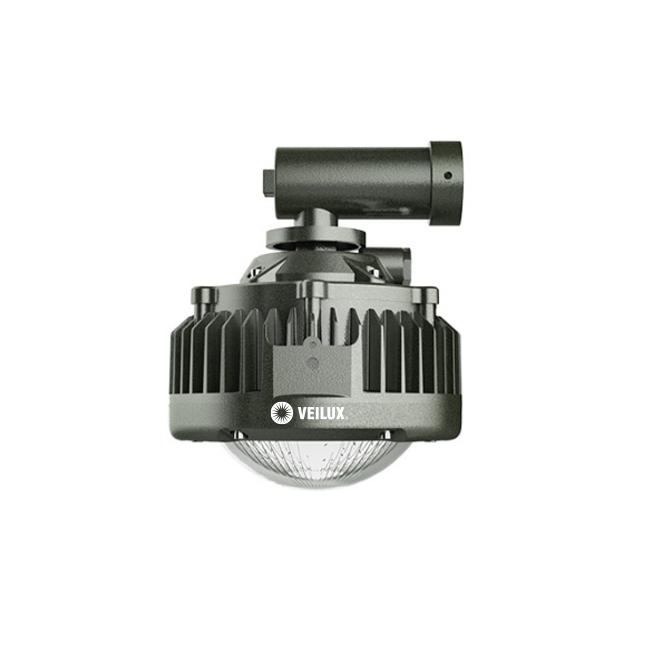
VL-EXO-8231-XX Explosion-Proof Hanging Lamp for Hazardous Locations (50W–90W)
Explosion-proof for Hazardous Locations
The VL-EXO-8231-XX Explosion-Proof Hanging Lamp is a pendant-mount industrial luminaire engineered for Class I Division 1/2 and ATEX/IECEx Zone 1/2 hazardous environments. Available in 50W, 60W, 70W, and 90W configurations, this lamp delivers high-efficacy LED illumination (≥130 lm/W) from a robust low-copper aluminum housing with a borosilicate glass globe lens for wide-angle distribution. The pendant installation style suits industrial workspaces where vertical clearance permits overhead suspension — including processing halls, tank farms, warehouse bays, and machinery rooms — providing 360° uniform illumination without shadows or hot spots that impede worker safety.

Technical Specifications
| Parameter | Specification |
|---|---|
| Model | VL-EXO-8231-XX (50W / 60W / 70W / 90W) |
| LED Efficacy | ≥130 lm/W |
| Luminous Flux | 6,500 lm (50W) / 7,800 lm (60W) / 9,100 lm (70W) / 11,700 lm (90W) |
| Input Voltage | 100–277V AC, 50/60Hz |
| Power Factor | ≥0.95 |
| THD | <10% |
| Color Temperature | 4000K / 5000K (neutral white / cool white) |
| CRI | ≥80 Ra |
| Beam Angle | 360° (globe lens) |
| Operating Temperature | -40°C to +55°C |
| Enclosure Rating | IP66 |
| Lens Material | Borosilicate glass globe |
| Housing Material | Low-copper aluminum alloy with powder coat |
| Mounting | Pendant/hanging, G3/4 top conduit entry |
| Rated Life | L80 ≥50,000 hours |
Certifications & Hazardous Area Ratings
| Standard | Classification |
|---|---|
| NEC (North America) | Class I Division 1 & 2, Groups B, C, D; Class II Division 1 & 2, Groups E, F, G; Class III |
| ATEX (Europe) | Ex II 2G Ex d IIC T4 Gb; Ex II 2D Ex tb IIIC T135°C Db |
| IECEx | Ex d IIC T4 Gb; Ex tb IIIC T135°C Db |
| Enclosure | IP66 (IEC 60529) |
| Vibration | IEC 60068-2-6 |
| DLC | Premium Listed |
Pendant Lamp vs. Bay Light: When to Choose Each
| Criterion | VL-EXO-8231 Pendant | High-Bay Mount |
|---|---|---|
| Beam distribution | 360° omnidirectional | Directional (90°–120°) |
| Mounting height | 3–8 m ideal | 6–20 m ideal |
| Uniformity | High (no dark corners) | Moderate (needs layout planning) |
| Ceiling structure needed | Pendant hook or I-beam | Rigid ceiling or beam |
| Best for | Workbenches, tank areas, processing stations | Wide-span warehouse, refinery bays |
Application Environments
- Petroleum Refineries: Process unit work areas and pump houses requiring Class I Div 1 Group D illumination
- Chemical Processing: Reactor and mixing areas with hydrogen sulfide (Group C) or propane atmospheres (Group D)
- Offshore Platforms: Machinery rooms, compressor halls, and deck areas requiring ATEX Zone 1 rating
- Grain & Feed Mills: Interior of silos and conveying areas with Class II Group G combustible grain dust
- Paint Spray Booths: Class I Div 1 solvent vapor environments per NFPA 33
Frequently Asked Questions
- What wattage should I choose for a 5-meter ceiling height?
- For a 5-meter ceiling height with 3m × 3m grid spacing, the 70W configuration (9,100 lm) typically achieves 50–60 lux at floor level — suitable for general process area illumination per IES RP-7 recommendations for industrial facilities. For task areas requiring 150+ lux, use 90W or reduce grid spacing.
- Is the VL-EXO-8231 rated for Group B (hydrogen) environments?
- Yes. The ATEX IIC and NEC Group B ratings cover hydrogen gas atmospheres, making the VL-EXO-8231-XX suitable for battery rooms, electrolysis facilities, and hydrogen generation areas where Group B classification applies.
- Can this lamp be installed in wet outdoor locations?
- Yes. The IP66 rating (dust-tight, protected against high-pressure water jets) qualifies the VL-EXO-8231-XX for covered outdoor locations including offshore weather decks, chemical plant exterior processing areas, and loading docks. For fully exposed outdoor installation, a weatherhood accessory is recommended.
- What is the recommended replacement schedule for the LED module?
- The LED module is rated L80 ≥50,000 hours, meaning it retains 80% of initial lumen output at 50,000 operating hours. At continuous operation this equates to approximately 5.7 years. Annual photometric surveys using a light meter are recommended to confirm maintained illuminance levels meet OSHA and NEC minimum requirements.
Certifications & Standards: IECEx International Certification System · EU ATEX Directive 2014/34/EU
Explosion for Hazardous Locations
This explosion-proof explosion is engineered for hazardous locations where standard equipment cannot operate safely. Certified for Class I Division 1 and Division 2 environments, it meets ATEX and IECEx standards for oil & gas, chemical, mining, and offshore installations.
Explore the full Veilux range of explosion-proof lighting for your industrial security requirements.
As a leading provider of explosion-proof solutions, Veilux delivers certified equipment built for hazardous environments. Our explosion-proof lineup is ATEX, IECEx, and UL listed for Class I Division 1 and Zone 1 applications.
Every explosion-proof unit undergoes rigorous testing to ensure reliable operation in explosive atmospheres.
All equipment in this category meets the rigorous safety requirements for classified hazardous locations. Independent certification to ATEX, IECEx, and UL standards verifies that each unit has been tested for use in explosive atmospheres found in petrochemical facilities, offshore platforms, grain handling operations, and chemical processing plants. These certifications are renewed on a defined schedule to reflect any design changes and to maintain compliance with evolving international standards.
Proper product selection depends on your site classification, mounting requirements, and operating environment. Class I Division 1 and Zone 1 environments demand the highest level of enclosure protection, while Division 2 and Zone 2 locations may permit designs with a lower protection level. Working with a certified hazardous-area specialist before finalising your specification helps ensure the installation meets both local electrical codes and applicable international standards without over-specifying the hardware.