
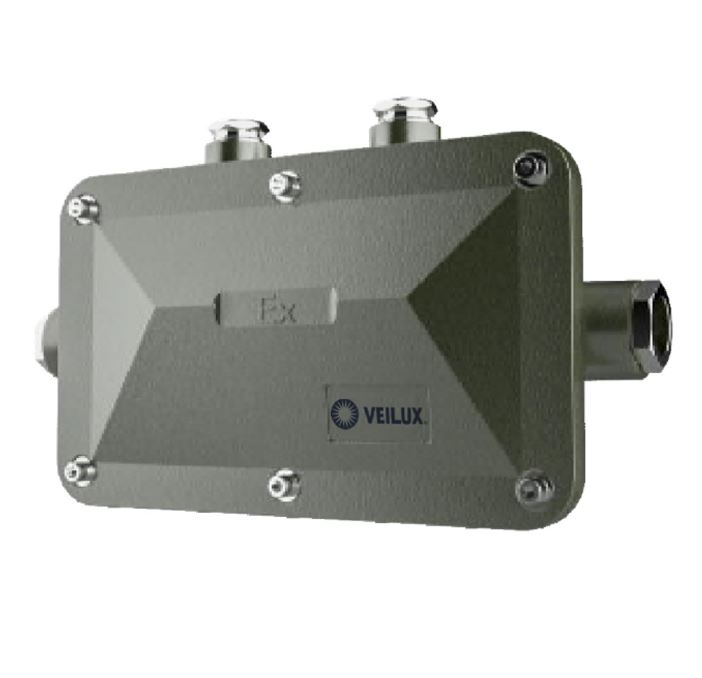
VL-EX8236B-ELB Explosion-Proof Emergency LED Light for Hazardous Locations
Explosion-proof for Hazardous Locations
The VL-EX8236B-ELB Explosion-Proof Emergency LED Light is an intelligent safety luminaire engineered for hazardous areas classified Class I Division 1/2 and ATEX/IECEx Zone 1/2. Designed for emergency egress and backup illumination, this unit activates automatically within 0.5 seconds during power loss, delivering over 90 minutes of uninterrupted LED illumination from its integrated rechargeable battery. The sealed IP66 housing protects against dust ingress and high-pressure water jets, making it suitable for offshore platforms, chemical processing facilities, oil refineries, and underground mining operations where reliable emergency lighting is a life-safety requirement under NEC Article 700 and NFPA 101.

Technical Specifications
| Parameter | Specification |
|---|---|
| Model | VL-EX8236B-ELB |
| LED Power | 8W (emergency mode) |
| Battery Backup | Lithium iron phosphate (LiFePO4), 90+ minutes |
| Luminous Flux | 800 lm (emergency mode) |
| Input Voltage | 100–277V AC, 50/60Hz |
| Operating Temperature | -40°C to +55°C (-40°F to +131°F) |
| Enclosure Rating | IP66 |
| Housing Material | Low-copper aluminum alloy, powder-coated |
| Impact Resistance | IK08 |
| Self-Test Interval | Automatic monthly and annual test cycle |
| Charging Time | ≤24 hours to full charge |
| Mounting | Wall/ceiling bracket, conduit entry G3/4 or M20 |
| Net Weight | 3.2 kg |
Certifications & Hazardous Area Ratings
| Standard | Classification |
|---|---|
| NEC (North America) | Class I Division 1 & 2, Groups C, D; Class II Division 1 & 2, Groups E, F, G; Class III |
| ATEX (Europe) | Ex II 2G Ex d IIB T4 Gb; Ex II 2D Ex tb IIIC T135°C Db |
| IECEx | Ex d IIB T4 Gb; Ex tb IIIC T135°C Db |
| Enclosure | IP66 (IEC 60529) |
| Emergency Standard | IEC 60598-2-22, NFPA 101 Life Safety Code |
| Energy Efficiency | DLC Listed |
Emergency Lighting Compliance Requirements
Emergency lighting in hazardous areas must satisfy dual compliance requirements: explosion-protection standards (NEC Article 501/ATEX) and emergency lighting standards (NEC Article 700, NFPA 101 Life Safety Code). The VL-EX8236B-ELB meets both simultaneously. Under NFPA 101, emergency lighting must illuminate to a minimum of 10.8 lux (1 ft-candle) at floor level for 90 minutes following power interruption — a threshold this unit exceeds. The self-testing function logs test results for OSHA inspection records, satisfying OSHA 29 CFR 1910.303 documentation requirements.
Industrial Applications
- Oil & Gas Refineries: Muster stations, process unit walkways, stairwells in Class I Div 1 areas
- Offshore Platforms: Accommodation corridors, machinery rooms, helideck areas requiring ATEX Zone 1 rating
- Chemical Plants: Evacuation routes through classified process areas
- Mining Operations: Underground egress lighting in Class I Group D atmospheres
- Wastewater Treatment: Pump rooms and electrical rooms per NFPA 820 Class I Div 1 classification
- Grain Processing: Emergency exit paths in Class II Group G dust-classified areas
Frequently Asked Questions
- What is the battery life of the VL-EX8236B-ELB?
- The VL-EX8236B-ELB uses a lithium iron phosphate (LiFePO4) battery that provides a minimum of 90 minutes of emergency illumination at 800 lumens. LiFePO4 chemistry offers over 2,000 charge cycles and maintains capacity down to -40°C, making it suitable for cold-climate hazardous locations.
- Does the emergency light require a separate test switch?
- No. The VL-EX8236B-ELB includes an automatic self-test cycle that runs monthly and annually without manual intervention. A status indicator LED reports normal/fault conditions. Manual test override is accessible via a recessed push-button without opening the explosion-proof enclosure.
- Can this unit be used in Class I Division 1 areas?
- Yes. The VL-EX8236B-ELB is rated for Class I Division 1, Groups C and D — the most stringent North American hazardous area classification for flammable gas atmospheres present under normal operating conditions. ATEX certification covers Zone 1 Group IIB gas environments.
- What installation conduit size does the VL-EX8236B-ELB accept?
- The unit accepts G3/4 or M20 conduit entries. In North American installations, a certified conduit seal (Crouse-Hinds EYS or equivalent) must be installed within 18 inches of the fitting as required by NEC 501.15 for Class I Division 1 locations.
Certifications & Standards: IECEx International Certification System · EU ATEX Directive 2014/34/EU
Explosion for Hazardous Locations
This explosion-proof explosion is engineered for hazardous locations where standard equipment cannot operate safely. Certified for Class I Division 1 and Division 2 environments, it meets ATEX and IECEx standards for oil & gas, chemical, mining, and offshore installations.
Explore the full Veilux range of explosion-proof lighting for your industrial security requirements.
As a leading provider of explosion-proof solutions, Veilux delivers certified equipment built for hazardous environments. Our explosion-proof lineup is ATEX, IECEx, and UL listed for Class I Division 1 and Zone 1 applications.
Every explosion-proof unit undergoes rigorous testing to ensure reliable operation in explosive atmospheres.
All equipment in this category meets the rigorous safety requirements for classified hazardous locations. Independent certification to ATEX, IECEx, and UL standards verifies that each unit has been tested for use in explosive atmospheres found in petrochemical facilities, offshore platforms, grain handling operations, and chemical processing plants. These certifications are renewed on a defined schedule to reflect any design changes and to maintain compliance with evolving international standards.
Proper product selection depends on your site classification, mounting requirements, and operating environment. Class I Division 1 and Zone 1 environments demand the highest level of enclosure protection, while Division 2 and Zone 2 locations may permit designs with a lower protection level. Working with a certified hazardous-area specialist before finalising your specification helps ensure the installation meets both local electrical codes and applicable international standards without over-specifying the hardware.