
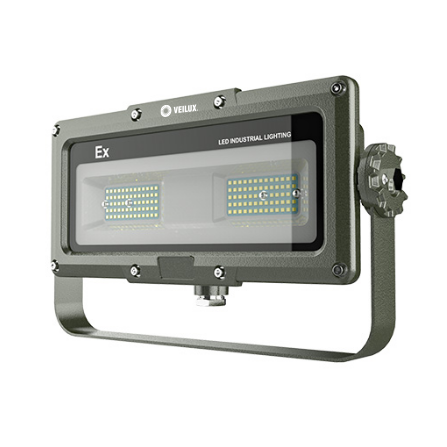
VL-EX8199-XXX Explosion-Proof Compact LED Floodlight for Hazardous Locations (80W–100W)
Explosion-proof for Hazardous Locations
The VL-EX8199-XXX Explosion-Proof Compact LED Floodlight is a wall-mount or adjustable-bracket luminaire designed for directed area lighting in Class I Division 1/2 and ATEX/IECEx Zone 1/2 hazardous environments. Available in 80W and 100W, it delivers up to 13,000 lumens with an asymmetric 60° × 90° beam pattern optimized for flood illumination of work surfaces, equipment yards, and perimeter security zones. The die-cast low-copper aluminum housing offers exceptional corrosion resistance for offshore and coastal refinery applications, while the toughened glass lens withstands thermal shock and mechanical impact without shattering in the event of a process upset.

Technical Specifications
| Parameter | Specification |
|---|---|
| Model | VL-EX8199-XXX (80W / 100W) |
| LED Efficacy | ≥130 lm/W |
| Luminous Flux | 10,400 lm (80W) / 13,000 lm (100W) |
| Input Voltage | 100–277V AC, 50/60Hz |
| Power Factor | ≥0.95 |
| Color Temperature | 4000K / 5000K |
| CRI | ≥80 Ra |
| Beam Angle | 60° × 90° asymmetric flood |
| Operating Temperature | -40°C to +55°C |
| Enclosure Rating | IP66 |
| Impact Resistance | IK09 |
| Lens Material | Tempered borosilicate glass |
| Housing Material | Die-cast low-copper aluminum, powder-coated |
| Mounting | Adjustable U-bracket, ±90° vertical / 360° horizontal |
| Conduit Entry | 2 × M20 or G3/4 |
| Rated Life | L80 ≥50,000 hours |
| Net Weight | 6.8 kg (80W) |
Certifications & Hazardous Area Ratings
| Standard | Classification |
|---|---|
| NEC (North America) | Class I Division 1 & 2, Groups B, C, D; Class II Division 1 & 2, Groups E, F, G; Class III |
| ATEX (Europe) | Ex II 2G Ex d IIC T4 Gb; Ex II 2D Ex tb IIIC T135°C Db |
| IECEx | Ex d IIC T4 Gb; Ex tb IIIC T135°C Db |
| Enclosure | IP66 (IEC 60529), NEMA 4X |
| Corrosion Resistance | ASTM B117 salt spray ≥500 hours |
| DLC | Premium Listed |
Floodlight Wattage Selection Guide
| Application | Target Illuminance | Mounting Distance | Recommended Wattage |
|---|---|---|---|
| Equipment inspection area | 200 lux | 5–8 m | 80W |
| Tank farm perimeter | 50 lux (security) | 10–15 m | 80W |
| Loading dock work area | 300 lux | 5–8 m | 100W |
| Offshore helideck perimeter | 100 lux | 8–12 m | 100W |
| Compressor station yard | 50 lux (OSHA minimum) | 12–20 m | 100W + reflector |
Industrial Applications
- Oil & Gas Production Facilities: Wellhead areas, separator skids, and manifold stations classified Class I Div 1 Group D
- Offshore Platforms: Open deck and equipment areas requiring Zone 1 IIC certification for hydrogen sulfide-containing gas streams
- Chemical Plants: Reactor building exterior walls and pipe rack areas with Group C/D hazards
- LNG Terminals: Cryogenic storage area perimeters per NFPA 59A Class I Div 1 requirements
- Wastewater Treatment: Digester tank perimeters classified Class I Div 1 under NFPA 820
Frequently Asked Questions
- What is the difference between the 80W and 100W versions of the VL-EX8199?
- Both versions share identical housing and mounting hardware. The 80W produces 10,400 lumens and suits medium-range flood applications (5–12 m mounting distance). The 100W produces 13,000 lumens for longer throws (10–20 m) or higher illuminance targets. Both meet DLC Premium efficacy requirements for utility incentive eligibility.
- Is the VL-EX8199-XXX suitable for replacement of 250W or 400W metal halide floodlights?
- Yes. The 100W VL-EX8199-XXX (13,000 lm) is a direct LED replacement for 250W metal halide floodlights (approx. 12,000–14,000 delivered lumens after fixture losses). The 80W version replaces 175W to 250W HID. Energy savings of 55–68% are typical versus equivalent HID wattage.
- Can I mount this floodlight vertically pointing upward?
- No. The adjustable bracket permits ±90° vertical adjustment, but upward-pointing installation (luminaire above horizontal) risks condensation accumulation on the lens seal and is not recommended. For uplighting applications, use a dedicated waterproof luminaire with IP68 rating or install a drain fitting.
- Does this floodlight include a photocell or motion sensor option?
- The standard VL-EX8199-XXX does not include an integrated sensor. A 0–10V dimming input is available for external sensor control. For autonomous operation in hazardous areas, a certified explosion-proof photocell rated for the same hazardous area classification must be wired to the dimming input from a safe distance per NEC 501.10.
Certifications & Standards: IECEx International Certification System · EU ATEX Directive 2014/34/EU
Explosion for Hazardous Locations
This explosion-proof explosion is engineered for hazardous locations where standard equipment cannot operate safely. Certified for Class I Division 1 and Division 2 environments, it meets ATEX and IECEx standards for oil & gas, chemical, mining, and offshore installations.
Explore the full Veilux range of explosion-proof lighting for your industrial security requirements.
As a leading provider of explosion-proof solutions, Veilux delivers certified equipment built for hazardous environments. Our explosion-proof lineup is ATEX, IECEx, and UL listed for Class I Division 1 and Zone 1 applications.
Every explosion-proof unit undergoes rigorous testing to ensure reliable operation in explosive atmospheres.
All equipment in this category meets the rigorous safety requirements for classified hazardous locations. Independent certification to ATEX, IECEx, and UL standards verifies that each unit has been tested for use in explosive atmospheres found in petrochemical facilities, offshore platforms, grain handling operations, and chemical processing plants. These certifications are renewed on a defined schedule to reflect any design changes and to maintain compliance with evolving international standards.
Proper product selection depends on your site classification, mounting requirements, and operating environment. Class I Division 1 and Zone 1 environments demand the highest level of enclosure protection, while Division 2 and Zone 2 locations may permit designs with a lower protection level. Working with a certified hazardous-area specialist before finalising your specification helps ensure the installation meets both local electrical codes and applicable international standards without over-specifying the hardware.