
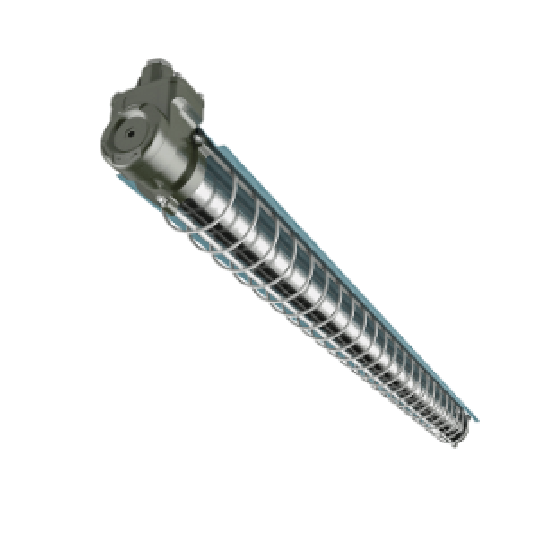
VL-EX8197D Explosion-Proof Double Linear LED Light for Hazardous Locations
Explosion-proof for Hazardous Locations
The VL-EX8197D Explosion-Proof Double Linear LED Light is a dual-tube industrial luminaire providing high-output ceiling illumination for Class I Division 1/2 and ATEX/IECEx Zone 1/2 hazardous environments. With two parallel LED tubes in a single housing unit, the VL-EX8197D delivers 10,000–15,000 lumens from an 80W–120W draw — equivalent to replacing two 150W fluorescent hazardous-location fixtures while eliminating UV emission, mercury content, and the maintenance burden of fluorescent tube replacement. The rigid die-cast housing provides mounting points for both surface-ceiling and suspended installation, with sealed polycarbonate diffusers ensuring even light distribution across process aisles, machinery bays, and inspection workstations.

Technical Specifications
| Parameter | Specification |
|---|---|
| Model | VL-EX8197D (80W / 120W) |
| LED Efficacy | ≥125 lm/W |
| Luminous Flux | 10,000 lm (80W) / 15,000 lm (120W) |
| Input Voltage | 100–277V AC, 50/60Hz |
| Power Factor | ≥0.95 |
| Color Temperature | 4000K / 5000K |
| CRI | ≥80 Ra |
| Beam Angle | 120° (opal polycarbonate diffuser) |
| Operating Temperature | -40°C to +55°C |
| Enclosure Rating | IP66 |
| Lens Material | UV-stabilized impact-resistant polycarbonate |
| Housing Material | Die-cast aluminum, powder-coated |
| Overall Length | 1,200 mm |
| Overall Width | 280 mm (double-tube) |
| Mounting | Surface ceiling, pendant, or conduit entry ends |
| Rated Life | L80 ≥50,000 hours |
Certifications & Hazardous Area Ratings
| Standard | Classification |
|---|---|
| NEC (North America) | Class I Division 1 & 2, Groups C, D; Class II Division 1 & 2, Groups E, F, G; Class III |
| ATEX (Europe) | Ex II 2G Ex d IIB T4 Gb; Ex II 2D Ex tb IIIC T135°C Db |
| IECEx | Ex d IIB T4 Gb; Ex tb IIIC T135°C Db |
| Enclosure | IP66 (IEC 60529) |
| DLC | Listed |
LED vs. Fluorescent: Direct Replacement Value
| Factor | VL-EX8197D LED (120W) | 2 × 75W Fluorescent HazLoc |
|---|---|---|
| Power consumption | 120W | 150W (+ ballast losses ~20%) |
| Lumen output (maintained) | 12,000 lm @ 50,000h | ~9,600 lm @ 5,000h |
| Lamp replacement | None (50,000h LED life) | Every 12,000h (~1.4 yrs) |
| Mercury content | None | ~15 mg per tube × 2 |
| UV emission | Negligible | Present (polymer degradation) |
| Energy savings vs HID | ~60% | Baseline |
Application Environments
- Oil Refinery Process Buildings: Indoor process units and laboratory buildings classified Class I Div 1 Group D
- Chemical Plant Warehouses: Storage buildings with Class I Div 2 Groups C/D classification
- Offshore Accommodation: Wider process corridors and utility rooms requiring Zone 2 IIB rating
- Pharmaceutical Manufacturing: Clean corridors and solvent areas requiring Class I Div 2 dual-tube lighting
- Paint Spray Buildings: Class I Div 1 high-lumen requirements for quality inspection
Frequently Asked Questions
- How does the VL-EX8197D differ from the VL-EX8197S?
- The VL-EX8197D is the double-tube version of the VL-EX8197S, providing approximately twice the lumen output (10,000–15,000 lm vs. 5,000–7,500 lm) in the same 1,200mm length. The D variant is 280mm wide versus 150mm for the S. Both share identical certifications, mounting hardware, and wiring configurations.
- Can the VL-EX8197D replace existing 2-lamp T5HO fluorescent fixtures in Class I Div 1 areas?
- Yes. The VL-EX8197D is a direct physical and electrical replacement for 2-lamp 54W T5HO or 4-lamp 32W T8 explosion-proof fluorescent fixtures with equivalent or greater lumen output. The mounting bolt pattern and conduit entry locations are compatible with most Class I Div 1 fluorescent fixture mounting templates.
- Is the VL-EX8197D rated for T4 temperature class?
- Yes. Both ATEX and IECEx certifications specify T4 surface temperature class (maximum surface temperature ≤135°C / 275°F), suitable for gas groups with auto-ignition temperatures above 135°C including propane (468°C), methane (537°C), and ethylene (425°C).
- What wire gauge is required for the VL-EX8197D?
- At 120V, a 120W load draws approximately 1.0A (or 0.5A at 277V). Minimum 14 AWG THWN-2 conductors are suitable for branch circuit wiring. For conduit runs exceeding 100 feet, upsizing to 12 AWG is recommended to limit voltage drop below 3%. Conduit seals per NEC 501.15 are mandatory in Class I Div 1 installations.
Certifications & Standards: IECEx International Certification System · EU ATEX Directive 2014/34/EU
Explosion for Hazardous Locations
This explosion-proof explosion is engineered for hazardous locations where standard equipment cannot operate safely. Certified for Class I Division 1 and Division 2 environments, it meets ATEX and IECEx standards for oil & gas, chemical, mining, and offshore installations.
Explore the full Veilux range of explosion-proof lighting for your industrial security requirements.
As a leading provider of explosion-proof solutions, Veilux delivers certified equipment built for hazardous environments. Our explosion-proof lineup is ATEX, IECEx, and UL listed for Class I Division 1 and Zone 1 applications.
Every explosion-proof unit undergoes rigorous testing to ensure reliable operation in explosive atmospheres.
All equipment in this category meets the rigorous safety requirements for classified hazardous locations. Independent certification to ATEX, IECEx, and UL standards verifies that each unit has been tested for use in explosive atmospheres found in petrochemical facilities, offshore platforms, grain handling operations, and chemical processing plants. These certifications are renewed on a defined schedule to reflect any design changes and to maintain compliance with evolving international standards.
Proper product selection depends on your site classification, mounting requirements, and operating environment. Class I Division 1 and Zone 1 environments demand the highest level of enclosure protection, while Division 2 and Zone 2 locations may permit designs with a lower protection level. Working with a certified hazardous-area specialist before finalising your specification helps ensure the installation meets both local electrical codes and applicable international standards without over-specifying the hardware.