
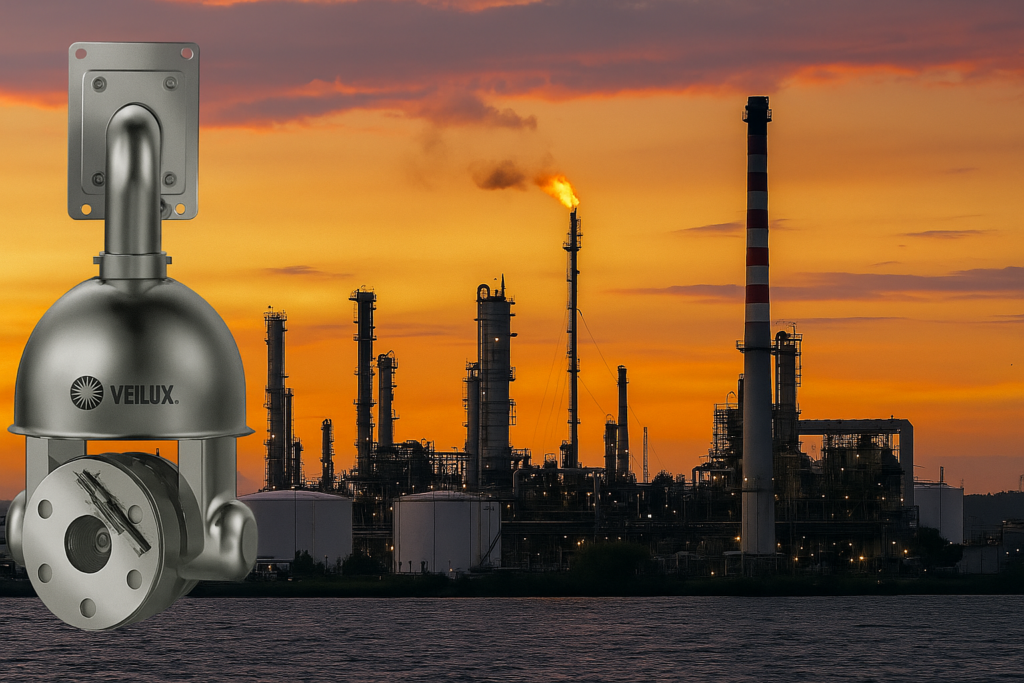
Explosion proof cameras hazardous environments systems from Veilux are engineered for the most demanding hazardous environments, certified for Class I Division 1 and Zone 1 areas. Our explosion proof cameras hazardous environments lineup meets ATEX, IECEx, and UL standards.
Explosion-proof cameras are certified electrical enclosures that contain any internal ignition within the housing, preventing it from propagating to surrounding flammable atmospheres. Required by NEC Article 501 (Class I Division 1 areas) and ATEX Zone 1 regulations globally, they are the primary surveillance solution for oil and gas, chemical, pharmaceutical, and mining facilities. This guide covers certifications, classifications, selection criteria, and installation requirements.
When you’re working in industries like oil and gas, chemical processing, or mining, safety isn’t optional, it’s everything. Even a tiny spark can trigger a serious accident. That’s why Explosion Proof Cameras aren’t just nice to have, they’re essential.
These cameras are designed to safely operate in areas with flammable gases, dust, or vapors. But beyond their rugged construction, they also give you peace of mind by keeping a constant eye on critical operations.
In this post, we’ll walk through what these cameras are, why they matter, the certifications you should look for, and how Veilux can help you protect your people and assets.
What Exactly Are Explosion Proof Cameras?
[rank_math_toc]
Explosion Proof Cameras Hazardous Environments for Hazardous Locations
Simply put, Explosion Proof Cameras are surveillance cameras built to prevent sparks, heat, or electrical arcs from igniting the surrounding environment. Their housings are made of strong materials like stainless steel or aluminum, and every internal component is designed to meet strict safety standards.
You’ll find these cameras in:
- Oil and gas refineries
- Offshore drilling platforms
- Chemical plants
- Grain storage facilities
- Mining operations
They’re more than just cameras, they’re a safety tool that can prevent disasters.
Why They’re So Important
Standard cameras can’t survive, or protect you, in hazardous environments. Here’s why explosion proof models are a must:
- Safety Comes First – They prevent sparks or heat from causing explosions.
- Compliance Made Easy – Certifications like ATEX, IECEx, and ATEX/IECEx ensure your facility meets legal safety requirements.
- Built to Last – Designed to resist corrosion, extreme temperatures, and harsh weather.
- Better Monitoring – Watch operations in real-time, spot leaks, and respond faster to issues.
- Long-Term Savings – Preventing accidents saves lives, money, and downtime.
For more details on hazardous location regulations, you can check OSHA’s Hazardous Locations standards
Certifications Matter
When shopping for Explosion Proof Cameras, certifications are key. Look for:
- ATEX – Required for equipment used in explosive environments in Europe.
- IECEx – International standard for safety in explosive atmospheres.
- ATEX/IECEx & C1D1/C1D2 – U.S. standards for areas where flammable gases or vapors may be present.
Veilux offers a variety of certified solutions, including C1D1 cameras, making it easier to stay compliant and safe.
Features That Make a Difference
Modern Explosion Proof Cameras do more than survive explosions, they give you advanced capabilities:
- 4K Ultra-HD video – Clear images for detailed monitoring
- Thermal imaging – Spot heat signatures, leaks, or equipment malfunctions
- Pan-Tilt-Zoom (PTZ) – Cover a wide area with a single camera
- Remote access – Monitor operations from anywhere
- IP66/IP68 protection – Dust- and water-resistant for tough outdoor conditions
Check out Veilux’s SVEX-TH125B Explosion-Proof Thermal Camera Housing for a great example of these capabilities in action.
Where You’ll Use Them
- Oil & Gas – Monitor pipelines, refineries, and rigs safely
- Chemical Plants – Keep an eye on tanks, valves, and reaction zones
- Food & Agriculture – Protect grain silos or flour mills from dust explosions
- Mining – Monitor underground and surface operations
For guidance on selecting the right solution, see our Certified Surveillance Systems for Hazardous Zones post.
Why Veilux
Veilux specializes in Explosion Proof Cameras built for real-world conditions. With ATEX, IECEx, and C1D1 certifications, our cameras are designed to keep your workplace safe and compliant.
Explore products like:
Final Thoughts
Working in hazardous locations isn’t easy, but the right tools make it safer. Explosion Proof Cameras protect your people, your assets, and your operations. Investing in certified, high-quality cameras isn’t just about compliance, it’s about peace of mind.
Protect your hazardous zone today. Contact Veilux to speak with a specialist.
Frequently Asked Questions
What makes a camera truly explosion-proof?
An explosion-proof camera is housed in a sealed enclosure that contains any internal sparks or heat, preventing ignition of surrounding flammable gases or vapors. True explosion-proof cameras carry ATEX, IECEx, or ATEX/IECEx certification for specific hazard classifications such as Class I Division 1 or Zone 1.
What is the difference between ATEX and IECEx explosion-proof certification?
ATEX certification is the European standard for explosive atmospheres under EU directives. ATEX/IECEx (international certification bodies) is the North American standard under NFPA 70. Both certify explosion-proof equipment but use different classification systems: ATEX uses Zone 0/1/2, while NEC uses Class I Division 1/2.
Do explosion-proof cameras require special installation?
Yes. Installation in hazardous locations must comply with NEC Article 505 or 501, ATEX Directive 2014/34/EU, or applicable local codes. All conduit entries, gland seals, and wiring methods must be rated for the specific hazardous classification. Installation must be performed by qualified electricians familiar with hazardous area requirements.
Can explosion-proof cameras operate in extreme temperatures?
Yes. Most ATEX and ATEX/IECEx certified explosion-proof cameras are rated for -40C to +70C. Always verify the T-code (temperature class) rating against your site's maximum surface temperature to ensure the camera surface will never reach the ignition temperature of the local gas group.
Explosion-Proof Camera Quick Reference
| Classification | When Required | Typical Applications |
|---|---|---|
| Class I Division 1 | Flammable gas present under normal conditions | Oil refinery process units, chemical reactors, pump houses |
| Class I Division 2 | Flammable gas only under abnormal conditions | Equipment rooms adjacent to process areas, outdoor pipe racks |
| ATEX Zone 1 | EU/IECEx equivalent of Division 1 | Same as Class I Division 1 in international facilities |
| ATEX Zone 2 | EU/IECEx equivalent of Division 2 | Same as Class I Division 2 in international facilities |
| Class II Division 1 | Combustible dust under normal conditions | Grain elevators, coal handling, flour mills, pharmaceutical |
| Class II Division 2 | Combustible dust only under abnormal conditions | Dust collection rooms, secondary processing areas |
Certification Standards at a Glance
| Certification | Standard | Market | What It Covers |
|---|---|---|---|
| ATEX/IECEx certified | applicable certification standards | USA | Class I/II Div 1 and 2 camera enclosures |
| IECEx Listed | applicable certification standards | Canada | Same as ATEX/IECEx for Canadian installations |
| ATEX Certified | EN 60079-1 | EU | Zone 0/1/2 gas, Zone 20/21/22 dust |
| IECEx Certified | IEC 60079-1 | 50+ countries | Same as ATEX, accepted internationally |
Further reading: Class 1 Division 1 vs Division 2 Guide | ATEX Zone Selection Guide | Housing Selection Guide | CCTV System Design for Hazardous Areas
Ready to specify for your facility? Request an Industrial Quote from Veilux’s hazardous location engineering team, or explore certified explosion-proof camera systems including PTZ, bullet, and housing configurations with ATEX, IECEx, ATEX/IECEx, and IECEx certifications.
Key Takeaways: Explosion-proof Cameras
Explosion-proof Cameras is essential equipment in hazardous classified environments where flammable gases, vapors, or dust may be present. Facilities relying on Explosion-proof Cameras benefit from enhanced safety and regulatory compliance with ATEX, IECEx, and ATEX/IECEx Certifications. When specifying Explosion-proof Cameras for your site, match the certification to your area classification — Zone 0/1/2 or Class I Division 1/2.
Explosion-proof Cameras from Veilux is available in fixed and PTZ configurations to suit perimeter, process, and critical-area coverage needs. Properly maintained Explosion-proof Cameras extends system life and upholds certification validity per NFPA 70E inspection requirements.
Sources & Standards: NFPA 70 — National Electrical Code (NEC) · IECEx International Certification System · EU ATEX Directive 2014/34/EU
Matching Explosion-Proof Camera Certifications to Your Hazardous Environment
Selecting the correct explosion-proof camera for a specific hazardous environment requires more than confirming that a product carries some form of hazardous-area certification—it requires matching the certification’s scope precisely to the area classification documented in the facility’s electrical area classification study. Under the North American NEC framework, Class I locations (flammable gases or vapors) are subdivided into Division 1 (continuous or intermittent presence under normal operations) and Division 2 (presence only under abnormal conditions), and further into gas groups A through D based on the ignition energy and explosion pressure characteristics of the specific gas or vapor.
A camera certified for Class I, Division 2, Group D is not compliant in a Class I, Division 1 location, even if the gas involved is the same Group D hydrocarbon.
Under the IEC/ATEX framework used in Europe and internationally, the equivalents are Zones and Categories. Zone 1 (gas present intermittently under normal operations) requires Category 2G equipment; Zone 0 (gas present continuously) requires Category 1G. Zone 21 (combustible dust present intermittently under normal operations) requires Category 2D. ATEX certifications carry the specific gas group and temperature class on the certificate—an ATEX Cat 2G, IIB, T4 camera is certified for Zone 1, for gases with ignition energy characteristic of Group IIB (ethylene family), at temperatures up to 135°C surface temperature.
Installing this camera in a Zone 1, IIC (hydrogen) location would be a serious code violation because IIC gases require more stringent containment than the camera’s certification covers.
Many modern explosion-proof cameras carry combined ATEX and IECEx certificates, which simplifies global procurement. The ATEX certificate covers European Union market placement; the IECEx certificate, issued under the IEC’s international certification system, covers deployment in participating countries including Australia, China, South Africa, and others. Reading a combined certificate requires confirming that both the ATEX and IECEx scopes cover the required zone, gas group, and temperature class—a certificate that covers Zone 2 under ATEX but Zone 1 under IECEx, or vice versa, is not equivalent for both applications.
Common certification mismatches encountered during safety audits include: cameras marketed as “explosion proof” that carry only UL listing for ordinary locations with no hazardous-area scope; cameras with Division 2 or Zone 2 certifications installed in Division 1 or Zone 1 locations; cameras certified for Group D (propane, gasoline) installed in Group C (ethylene) or Group B (hydrogen) environments; and cameras with expired certificates or certificates that were withdrawn after product modifications.
Verifying the current status of a camera’s certification directly on the certifying body’s online registry—UL Product iQ, CSA CAPP, FM Approvals database, ATEX Notified Body certificate archives, or IECEx OD—before purchase prevents these costly and potentially dangerous mismatches.
Environmental Durability Requirements for Hazardous Location Cameras
The explosion-proof certification of a camera addresses ignition prevention—it does not address the camera’s ability to survive the environmental conditions of a specific hazardous area. Environmental durability must be specified and verified separately, using the appropriate IEC and industry standards for the deployment environment. IP (Ingress Protection) rating per IEC 60529 is the starting point. IP66 (dust tight, powerful water jet resistant) is adequate for most indoor and sheltered outdoor installations.
IP67 adds resistance to temporary immersion at 1 meter depth for 30 minutes—appropriate for installations in pits, trenches, or areas subject to flooding. IP68 extends immersion protection to defined pressures and depths specified by the manufacturer and is required for permanently submerged or frequently inundated installations.
Coastal and offshore petrochemical facilities subject cameras to salt-laden atmospheric corrosion that can destroy standard carbon steel or low-grade stainless steel housings within months. Salt fog endurance testing per ASTM B117 (500 or 1,000 hours minimum) provides a standardized measure of corrosion resistance. Housing materials for severe marine environments should be 316L stainless steel or marine-grade aluminum alloy with anodized or powder-coated exterior surfaces. Fasteners—a frequent corrosion failure point—should be A4 (316 grade) stainless steel throughout.
Sour service environments containing hydrogen sulfide (H₂S) require specific material selection. Standard austenitic stainless steels are susceptible to sulfide stress cracking (SSC) under H₂S partial pressure above 0.0003 MPa. Camera housings for sour service should comply with NACE MR0175/ISO 15156, specifying austenitic stainless steel grades or corrosion-resistant alloys (CRAs) qualified for the H₂S partial pressure and temperature of the installation. Elastomeric seals and gaskets must also be H₂S-compatible; fluorocarbon (Viton) or EPDM are preferred over nitrile rubber for sour service applications.
Temperature extremes present both high and low challenges. Refrigerated warehouses, cold storage facilities, and Arctic installations expose cameras to temperatures well below the -20°C lower limit of standard cameras. Cameras for cold environments must be specified with integral thermostatically controlled heater/blower combinations that maintain the internal temperature above the condensation point and the optical system above its minimum operating temperature. At the high end, cameras near furnaces, kilns, or direct sunlight in tropical climates can experience ambient temperatures approaching or exceeding +60°C.
Cameras for high-temperature environments require rated operating temperature verification at the expected maximum ambient, and solar shields or forced-air cooling when ambient exceeds the camera’s rated upper limit. Impact resistance rated to IK10 (20 joules, IEC 62262) provides protection against dropped tools, vehicle brush contacts, and environmental projectiles in active industrial environments and should be specified whenever the installation is outside a controlled area.
System Integration Considerations for Hazardous Environment Camera Networks
Installing individual explosion-proof cameras is only the first step in building a functional hazardous environment surveillance system. Integrating those cameras into a cohesive network that delivers video to operators and records footage for forensic review requires careful planning of VMS compatibility, power delivery, network architecture, and the critical transitions between classified and safe areas. Video Management System (VMS) compatibility is the first integration consideration.
Explosion-proof cameras from specialty manufacturers do not always support the full feature set of major VMS platforms—analytics, PTZ control, two-way audio, and edge recording—through standard ONVIF profiles. Before specifying cameras for a large deployment, verify VMS compatibility through a proof-of-concept test using the actual VMS version deployed in the facility, not just the vendor’s compatibility matrix, which may reference older VMS versions.
Power delivery options in classified areas include Power over Ethernet (PoE), 24VAC, and 24VDC, each with different installation implications. PoE simplifies installation by combining power and data on a single Cat6 cable, but the maximum cable length of 100 meters from the PoE switch to the camera is a hard physical constraint in large facilities. In classified areas, the PoE switch must either be installed in a safe area with a cable run to the camera within the 100-meter limit, or an intermediate PoE extender (which must itself be classified for the area) must be used.
24VAC or 24VDC power from a central power supply via separate conductors eliminates the 100-meter PoE constraint but adds wiring complexity and requires additional conductors in each conduit run.
Intrinsically safe (IS) network architectures use IS barriers—Zener barriers or galvanic isolators—to limit the electrical energy entering the classified area to levels below the minimum ignition energy of the hazardous atmosphere. IS camera systems certified for Zone 0 or Division 1 operations use this approach, with Zener barriers or galvanic isolators installed in the safe area DIN rail assembly, and special IS-rated cable and connectors in the hazardous zone.
Zener barriers are simple and inexpensive but require a high-integrity grounding system; galvanic isolators are more expensive but tolerate higher ground loop impedance and are preferred in installations where grounding quality cannot be guaranteed.
Fiber optic media converters at zone boundaries are one of the most practical tools for building hazardous environment camera networks in large facilities. By converting the electrical Ethernet signal to optical fiber at the classified zone boundary, fiber optic converters eliminate the ground loop and electrical noise issues associated with long copper runs through industrial environments, provide inherent electrical isolation between the classified area and the safe-area network, and enable camera-to-NVR runs of up to 80 kilometers on single-mode fiber—far beyond any copper Ethernet constraint.
The media converter on the safe-area side of the boundary can be a standard industrial unit; the converter on the classified-area side must be rated for the zone. NVR and recording infrastructure should always be located in a safe area, not in the classified zone, to avoid the cost and complexity of explosion-proof server enclosures and to simplify maintenance access for IT and security personnel.
As a leading provider of explosion proof cameras hazardous environments solutions, Veilux delivers certified equipment built for hazardous environments. Our explosion proof cameras hazardous environments lineup is ATEX, IECEx, and UL listed for Class I Division 1 and Zone 1 applications. Every explosion proof cameras hazardous environments unit undergoes rigorous testing to ensure reliable operation in explosive atmospheres.
Veilux engineers are available to help you specify the right explosion proof cameras hazardous environments system for your site requirements. Explore our full selection of explosion proof cameras hazardous environments equipment and request a custom quote today.
Need explosion-proof cameras for your facility?
Veilux has designed and supplied explosion-proof surveillance systems for oil refineries, chemical plants, offshore platforms, grain elevators, and mining operations. Our engineers review your hazardous area classification and specify certified cameras that meet every code requirement.

About the Author
Daniel Fernandez
Daniel Fernandez is a hazardous area security systems specialist with over a decade of experience specifying ATEX, IECEx, UL Class I Division 1, and cUL certified surveillance equipment for oil and gas, chemical, mining, pharmaceutical, and offshore environments. He holds expertise in NEC and IEC area classification standards and has consulted on explosion-proof camera system designs across North America, Europe, and the Middle East.